/pcq/media/agency_attachments/2025/02/06/2025-02-06t100846387z-pcquest-new-logo-png.png)


 Follow Us
/pcq/media/media_files/2025/12/18/google-makes-gemini-3-flash-the-default-model-in-the-gemini-app-2025-12-18-16-25-20.jpg)
Google has quietly rolled out a major change to its AI strategy, and it could shape how millions of people use AI every day. Gemini 3 Flash is now the default model inside the Gemini app and Google Search AI Mode worldwide, signaling a clear shift toward faster, more practical AI. Built for speed, lower cost, and everyday tasks, Gemini 3 Flash delivers strong reasoning, solid coding skills, and advanced multimodal features without heavy delays. Instead of chasing only the most powerful models, Google is focusing on AI that works smoothly, scales easily, and fits naturally into daily workflows.
Google’s latest AI bet goes mainstream
Google is betting big on speed and scale. On December 17, the company began rolling out Gemini 3 Flash as the default AI model across the Gemini app and AI Mode in Search, replacing Gemini 2.5 Flash. The move signals a clear priority shift. Instead of pushing only the most powerful models, Google is focusing on practical AI that works quickly, costs less, and fits into daily workflows. Users can still manually switch to Gemini 3 Pro for demanding tasks such as advanced math or deep coding, but Flash is now the first experience most people will see.
Why Gemini 3 Flash matters
Gemini 3 Flash is part of Google’s broader Gemini 3 family, but it plays a distinct role. Google describes it as a “workhorse” model, built to handle high-volume, real-time tasks with minimal delay.
According to Google, the model:
Responds faster than larger frontier models
Uses 30% fewer tokens on average compared to Gemini 2.5 Pro
Allows developers to control how deeply the model “thinks”, balancing speed and reasoning
This approach reflects a growing industry trend: AI that is good enough, fast enough, and affordable enough to run everywhere.
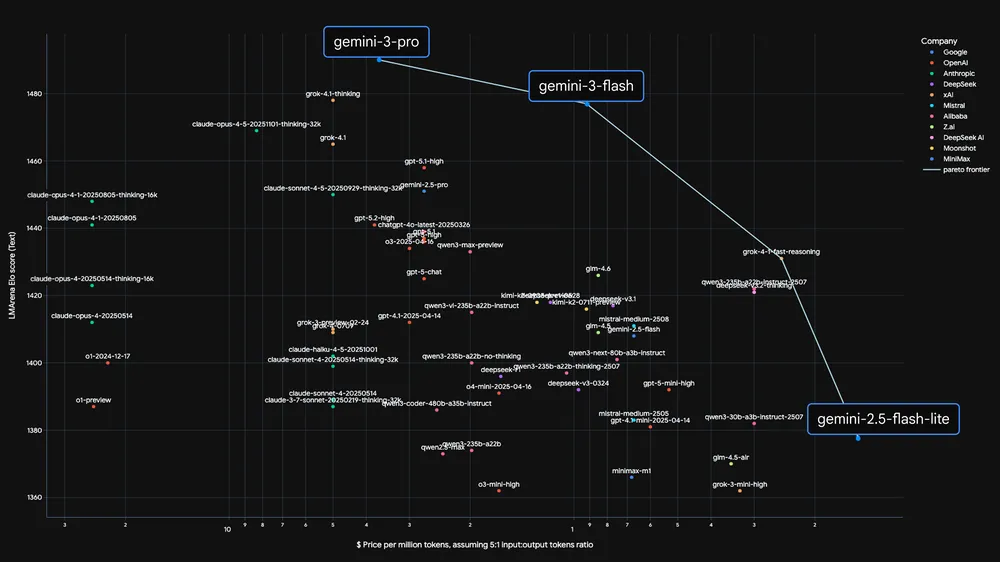
How Gemini 3 Flash performs in benchmarks
Google has shared several benchmark results to support its claims.
- On Humanity’s Last Exam, Gemini 3 Flash scored 33.7% without tool use. That places it close to Gemini 3 Pro at 37.5% and slightly below GPT-5.2 at 34.5%, while far outperforming Gemini 2.5 Flash at 11%.
- On MMMU-Pro, a benchmark that measures multimodal understanding, Gemini 3 Flash reached 81.2%, outperforming several competing models.
For software development tasks, the model scored 78% on SWE-bench Verified, a respected benchmark for coding agents. Google notes that only Gemini 3 Pro and GPT-5.2 scored higher in that category. While benchmarks never tell the full story, the numbers suggest Gemini 3 Flash offers near-frontier performance at much lower cost and latency.
Multimodal AI built for everyday use
Gemini 3 Flash is designed to handle more than text. Google highlighted several practical multimodal features, including:
Uploading short videos for sports or movement analysis
Sketch recognition while drawing
Audio uploads for summaries, analysis, or quiz generation
Visual answers that combine text, images, and tables
These features aim to make AI feel less like a chatbot and more like a daily assistant embedded across Google products.
Pricing and developer access
Google has also made Gemini 3 Flash widely available for developers and businesses.
Pricing is set at:
$0.50 per million input tokens
$3.00 per million output tokens
The model is accessible through Vertex AI, Gemini Enterprise, and, in preview, via the Gemini API. It also integrates with tools such as Google AI Studio, Gemini CLI, and Google’s agentic development platform, Antigravity. Companies such as JetBrains, Figma, Cursor, Harvey, and Latitude are already using Gemini 3 Flash, according to Google.
The bigger picture
By making Gemini 3 Flash the default, Google is sending a clear message: the future of AI is not just about raw power, but about usability at scale. Faster responses, lower costs, and multimodal capabilities may matter more to everyday users than marginal gains on benchmarks.
For now, Gemini 3 Flash represents Google’s attempt to put capable AI into as many hands, and as many searches, as possible.
More For You
Google unveils Gemini 3: A leap forward in AI
2025 Tech inflection point: where hype met hard truth
From prompt workflows to composable agents: The next step in enterprise GenAI architecture